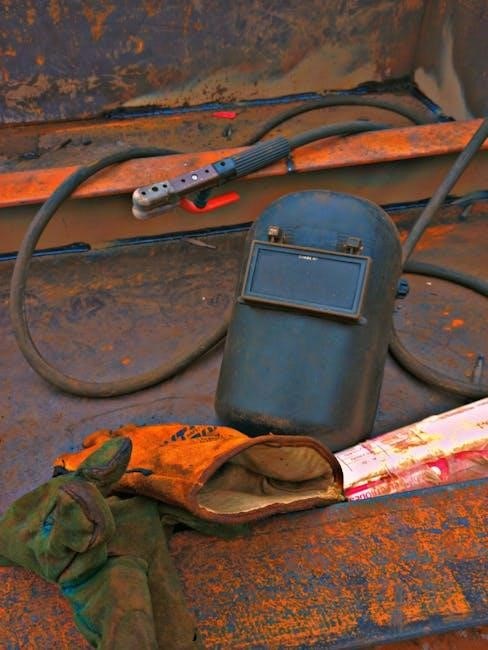

MIG Welding Wire Speed and Voltage Chart: A Comprehensive Guide
Navigating MIG welding demands precise settings; a chart simplifies this, correlating wire speed, voltage, and amperage for optimal results.
These charts, often in PDF format, are invaluable tools for both novice and experienced welders, ensuring strong, clean welds across various materials and thicknesses.
Mastering MIG (Metal Inert Gas) welding hinges on understanding the interplay between wire speed, voltage, and amperage – the foundational settings dictating weld quality. A PDF chart serves as a crucial starting point, offering recommended parameters based on material type, thickness, and wire diameter. These charts aren’t rigid rules, but rather guidelines to achieve a stable arc and desired weld characteristics.
Initial settings, gleaned from a chart, are then fine-tuned based on visual cues during welding. Consistent travel speed is paramount, maintaining a uniform bead. Remember, variations exist between machines and wire types, necessitating adjustments. The charts typically display wire feed speed, voltage, and amperage, alongside polarity recommendations. Successfully interpreting these settings, often found in PDF format, is key to preventing common issues like porosity or burn-through, ultimately leading to structurally sound welds.
Understanding the Relationship Between Wire Speed and Voltage
The connection between wire speed and voltage in MIG welding is fundamental. Voltage controls the arc length and width of the weld bead, while wire speed dictates the amount of filler metal deposited. Increasing voltage generally requires a corresponding increase in wire speed to maintain a stable arc and prevent burn-through. A PDF chart illustrating these relationships is invaluable.
Conversely, lowering voltage necessitates reducing wire speed. Imbalance leads to issues: too much voltage with insufficient wire speed causes a scattered, inconsistent arc. Too little voltage with excessive wire speed results in stubbing and poor fusion. PDF guides often present this as a coordinated adjustment – a slight voltage change demands a wire speed tweak. Mastering this interplay, guided by a chart, ensures optimal penetration, bead profile, and overall weld integrity, regardless of material.
Importance of a MIG Welding Chart
A MIG welding chart, frequently available as a PDF download, is crucial for achieving consistent, high-quality welds. These charts consolidate recommended settings – wire feed speed, voltage, and amperage – based on material type, thickness, and wire diameter. They serve as a starting point, eliminating guesswork and minimizing wasted material.
Without a chart, welders risk incorrect settings leading to porosity, lack of penetration, or burn-through. PDF charts often include specific recommendations for different gases and joint configurations. They’re particularly helpful when transitioning between materials like mild steel, stainless steel, and aluminum. Experienced welders still use them as a reference, while beginners find them indispensable for learning proper technique and understanding the impact of each setting on the final weld. They promote efficiency and reduce defects.
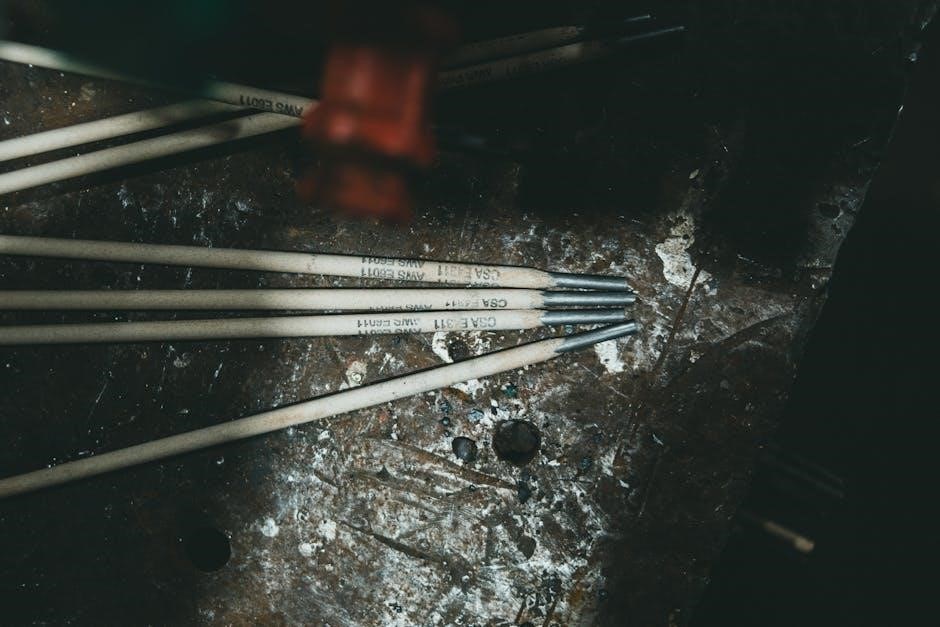
Factors Influencing MIG Welding Settings
Several elements dictate optimal settings, detailed in PDF charts; material, wire diameter, gas type, and metal thickness all impact wire speed and voltage requirements.
Material Type (Steel, Stainless Steel, Aluminum)
Selecting the correct MIG welding settings hinges significantly on the material being joined, as detailed within comprehensive PDF charts. Mild steel, being the most common, generally utilizes lower voltages and higher wire feed speeds compared to stainless steel or aluminum. Stainless steel demands reduced heat input to prevent distortion and maintain corrosion resistance, necessitating adjustments to both voltage and wire speed as indicated in specialized charts.
Aluminum, notoriously heat-sensitive, requires even lower voltages, higher wire feed speeds, and often a pulse setting for controlled heat input. These settings are crucial for preventing burn-through and achieving a quality weld. PDF guides often categorize settings by alloy type within each material category. Understanding these nuances, and referencing a detailed chart, is paramount for successful MIG welding across diverse materials. Different gas mixes are also required for each material type, further influencing the optimal settings.
Wire Diameter (0.030″, 0.035″, 0.045″)
Wire diameter profoundly impacts MIG welding parameters, and PDF charts meticulously outline these relationships. Thinner wires, like 0.030″, are ideal for sheet metal and require lower voltage and wire feed speeds to prevent burn-through. Conversely, 0.045″ wire, suited for thicker materials, demands higher voltage and wire feed speeds to achieve adequate penetration.
A 0.035″ diameter represents a versatile middle ground, offering a balance between maneuverability and penetration. PDF guides typically present separate setting tables for each wire diameter, specifying optimal ranges for voltage, wire feed speed, and amperage. Selecting the correct wire diameter, and then consulting a corresponding chart, ensures a stable arc and a quality weld. Remember that increasing wire diameter generally necessitates increasing gas flow rate for adequate shielding.
Gas Type and Flow Rate
Shielding gas is crucial in MIG welding, and PDF charts detail appropriate gas types and flow rates based on the material being welded. Argon/CO2 mixes are common for steel, with the ratio influencing weld properties; more CO2 enhances penetration, while more Argon improves weld appearance. Stainless steel typically requires pure Argon or Argon/Oxygen mixtures to prevent oxidation.

Aluminum welding necessitates pure Argon. PDF guides specify flow rates, usually in cubic feet per hour (CFH) or liters per minute (LPM), which are vital for adequate shielding. Insufficient flow leads to porosity, while excessive flow can cause turbulence and poor weld quality. Charts often correlate gas flow rate with wire diameter and welding current, providing a comprehensive reference for optimal settings.
Metal Thickness
PDF MIG welding charts meticulously categorize settings by metal thickness, a primary determinant of heat input. Thinner materials demand lower voltage and wire feed speeds to prevent burn-through, while thicker materials require increased settings for adequate penetration. Charts typically present thickness ranges in gauges (e.g., 18 gauge, 16 gauge) or millimeters (mm), offering clear guidance.
The charts illustrate how amperage, voltage, and wire feed speed must be adjusted proportionally to the metal’s thickness. For instance, welding 1/8” steel necessitates different parameters than welding 1/4” steel. PDF guides often include specific recommendations for fillet welds versus butt welds, further refining the settings based on joint configuration and desired weld strength. Accurate thickness measurement is paramount for utilizing these charts effectively.

MIG Welding Settings for Mild Steel
PDF charts provide starting points for mild steel, varying by wire diameter and thickness. Adjustments are crucial for optimal welds, based on specific conditions.
0.030″ Wire Diameter ― Mild Steel Settings
Utilizing a 0.030″ wire diameter for mild steel welding requires careful attention to settings, often detailed in PDF charts. For 22-gauge (0.8mm) steel, a starting point is approximately 16.5-19.5 volts with a wire feed speed of 21.9-23.6 inches per minute. As the material thickness increases to 18-gauge (1.2mm), voltage can rise to 19.5-20.5 volts, and wire feed speed to 31.0 inches per minute.
These values are merely guidelines; adjustments are essential. Consistent travel speed is paramount for a stable arc and uniform bead. Remember that amperage correlates with these settings, generally increasing with voltage and wire feed speed. Spot welding with this wire size might utilize around 5.5 volts and 21.9 inches per minute. Always consult a comprehensive PDF chart and fine-tune based on weld appearance and penetration.
0.035″ Wire Diameter ⎯ Mild Steel Settings
Employing a 0.035″ wire diameter for mild steel demands precise settings, readily available in detailed PDF charts. For 16-gauge (1.6mm) steel, initial settings typically range from 20.5 to 21.5 volts, coupled with a wire feed speed of 6.0 to 7.0 meters per minute. Increasing the material thickness to 1/8″ (3mm) necessitates adjustments, potentially reaching 21.5 to 22.5 volts and a wire feed speed of 7.0 meters per minute.
These figures serve as a foundational starting point, requiring careful refinement. Maintaining a consistent travel speed is crucial for arc stability and bead uniformity. Remember amperage increases alongside voltage and wire feed speed. A PDF chart will often provide amperage guidance. Spot welding parameters may involve approximately 5.6 volts and 31.0 inches per minute. Always prioritize a chart and adjust based on visual weld quality.
0.045″ Wire Diameter ⎯ Mild Steel Settings
Utilizing a 0.045″ wire diameter for mild steel welding requires referencing a comprehensive PDF chart for optimal settings. For 1/8″ (3mm) thick steel, a starting point often involves a voltage between 21.5 and 23.0 volts, paired with a wire feed speed ranging from 6.0 to 8.0 meters per minute. When tackling thicker 3/16″ (4.5mm) material, adjustments are essential, potentially increasing the voltage to 22.5-23.0 volts and the wire feed speed to 7.0-8.0 meters per minute.
These values are merely initial guidelines; fine-tuning is paramount. A PDF chart will correlate amperage to these settings. Consistent travel speed is vital for a stable arc and uniform bead. Remember, thicker materials demand higher settings. Spot welding with this diameter might utilize around 5.5 volts and 21.9 inches per minute. Always prioritize the chart and adjust based on weld appearance and penetration.
MIG Welding Settings for Stainless Steel
Stainless steel demands specific settings, detailed in PDF charts, differing from mild steel; gas mixes, voltages, and heat management are crucial for success.
Stainless Steel Settings with 0.030″ Wire
Utilizing a 0.030″ wire diameter for stainless steel MIG welding requires careful attention to settings, often detailed in comprehensive PDF charts. These charts typically provide a starting point, acknowledging that adjustments are frequently necessary based on joint configuration, material thickness, and desired weld characteristics. For 22-gauge (0.8mm) stainless steel, a voltage around 16.5V and a wire feed speed of approximately 21.9 inches per minute can be a good initial setting.
However, for 18-gauge (1.2mm) material, increasing the voltage to 19.5V and the wire feed speed to 23.6 inches per minute is generally recommended. Remember that these values are guidelines; observing the weld pool and adjusting accordingly is paramount. Argon/CO2 mixes are common shielding gases, and flow rates should be optimized to prevent porosity. PDF charts often include amperage correlations, aiding in fine-tuning the process for optimal penetration and bead profile. Always prioritize safety and consult multiple resources for a thorough understanding.
Stainless Steel Settings with 0.035″ Wire
Employing 0.035″ wire for stainless steel MIG welding necessitates referencing detailed charts, frequently available as PDF downloads. These resources correlate material thickness with optimal voltage and wire feed speed settings. As a starting point, for stainless steel around 16-gauge (1.6mm), a voltage setting of approximately 20.5V and a wire feed speed around 31.0 inches per minute often yields satisfactory results.
For thicker 1/8″ (3mm) stainless steel, increasing the voltage to 21.5V and the wire feed speed to 34.6 inches per minute is generally advised. Argon-rich shielding gas mixtures are preferred for stainless steel to maintain corrosion resistance. PDF guides often detail amperage ranges corresponding to these settings. Consistent travel speed is crucial for a stable arc and uniform bead. Remember to adjust parameters based on weld appearance and penetration, and always prioritize safety precautions when welding.
Stainless Steel Settings with 0.045″ Wire
Utilizing 0.045″ wire for stainless steel MIG welding demands precise settings, best accessed through comprehensive charts, often in PDF format. For 1/8″ (3mm) stainless steel, a starting point involves a voltage around 22.5V and a wire feed speed of approximately 45 inches per minute. Thicker materials, like 3/16″ (4.5mm), typically require increased voltage – around 23V – and a wire feed speed of 50-55 inches per minute.
Argon-based shielding gases are essential for maintaining stainless steel’s corrosion resistance. PDF guides will correlate these settings with amperage ranges, typically between 185-210A. Maintaining a consistent travel speed is vital for a stable arc and uniform weld bead. Remember, these are initial settings; adjustments are often needed based on weld appearance and penetration. Always consult safety guidelines and wear appropriate protective gear during welding operations.

MIG Welding Settings for Aluminum
Aluminum welding requires specific settings detailed in PDF charts, focusing on wire speed, voltage, and gas flow for optimal results and bead quality.
Aluminum Settings with 0.035″ Wire
Utilizing a 0.035″ wire diameter for aluminum MIG welding necessitates careful attention to settings, often detailed in comprehensive PDF charts. These charts typically recommend a voltage range of 19-24 volts, contingent upon the aluminum alloy and thickness. Wire feed speed generally falls between 200-350 inches per minute (IPM), again, varying with material properties.
Crucially, 100% Argon gas is essential for shielding, with a flow rate of 20-25 cubic feet per hour (CFH). Amperage will typically range from 120-180 amps. Remember these are starting points; adjustments are vital based on weld appearance and penetration. A PDF chart will often provide specific settings for different aluminum grades like 5052 or 6061, and varying thicknesses from 1/8″ to 3/16″. Proper technique, including consistent travel speed, is paramount for success. Always consult a detailed chart for precise parameters.
Aluminum Settings with 0.045″ Wire
Employing a 0.045″ aluminum MIG welding wire demands higher settings compared to smaller diameters, as detailed in readily available PDF charts. Expect a voltage range of 22-28 volts, adjusted based on alloy and thickness. Wire feed speed typically spans 250-400 inches per minute (IPM), requiring precise control for optimal results.
Maintaining a 100% Argon shielding gas flow rate of 25-30 cubic feet per hour (CFH) is critical. Amperage generally falls between 150-220 amps. These values serve as initial guidelines; fine-tuning is essential based on weld puddle behavior. A comprehensive PDF chart will delineate settings for various aluminum alloys (e.g., 5052, 6061) and thicknesses, from 3/16″ up to 1/4″. Consistent travel speed and proper joint preparation are vital for achieving strong, clean aluminum welds. Always prioritize referencing a detailed chart.
Decoding a MIG Welding Settings Chart (PDF)
MIG welding charts, often in PDF format, detail wire feed speed (WFS), voltage, and amperage; understanding these parameters is key to successful welding.
Reading Wire Feed Speed (WFS)
Wire Feed Speed (WFS), measured in inches per minute (IPM) or meters per minute, dictates the amount of welding wire supplied to the weld pool. PDF charts typically display WFS as a primary setting, directly influencing weld penetration and bead size. Higher WFS values deliver more wire, resulting in wider, flatter beads and increased heat input, suitable for thicker materials or faster travel speeds. Conversely, lower WFS values produce narrower, more focused beads with less heat, ideal for thinner metals.
Accurately interpreting WFS requires considering the wire diameter; a smaller diameter necessitates a faster feed speed to achieve the same deposition rate as a larger diameter. Charts often categorize WFS recommendations based on wire size and material thickness. Remember that WFS is interconnected with voltage – adjusting one invariably requires adjusting the other to maintain a stable arc and desired weld characteristics. Consistent travel speed also plays a crucial role in maintaining a stable arc and uniform bead.

Interpreting Voltage Settings
Voltage, displayed on a PDF MIG welding chart, controls the arc length and width of the weld bead. Higher voltage settings create a wider, flatter bead with increased penetration, ideal for thicker materials and bridging gaps. Lower voltage settings produce a narrower, more focused bead with less penetration, better suited for thinner metals and precise welds. Voltage directly impacts the arc’s electrical characteristics, influencing its stability and the amount of heat transferred to the workpiece.
Charts typically present voltage ranges corresponding to specific wire feed speeds and material types. It’s crucial to understand that voltage and wire feed speed are interdependent; adjusting one requires a corresponding adjustment to the other to maintain a stable arc. Incorrect voltage settings can lead to issues like porosity or burn-through, so careful interpretation of the chart is essential for achieving optimal weld quality.
Understanding Amperage Correlation
Amperage, though often not directly displayed on a PDF MIG welding chart, is intrinsically linked to wire feed speed and voltage. It represents the current flowing through the welding arc, directly influencing the heat input and melting rate of the wire and base metal. Higher amperage equates to greater heat, enabling deeper penetration and faster welding speeds, suitable for thicker materials. Conversely, lower amperage reduces heat input, ideal for thinner metals to prevent burn-through.
Charts indirectly indicate amperage through recommended wire feed speed and voltage combinations; As wire feed speed increases, so does amperage, assuming a consistent voltage. Understanding this correlation is vital for controlling the weld pool and achieving the desired bead profile. Experienced welders often adjust wire feed speed to fine-tune amperage, based on visual cues and the specific application.
Spot Welding Settings Reference
Spot welding with a MIG welder, while less common than continuous welding, requires specific settings often found within comprehensive PDF charts. These charts provide a starting point for achieving consistent, reliable spot welds. Typically, spot welding utilizes lower voltages and wire feed speeds compared to fillet or butt welds, minimizing heat input and preventing distortion.
A reference chart might suggest settings around 5.5-6.5 volts and 21.9-34.6 inches per minute for thinner gauge steel (22-18 gauge), using a .030″ or .035″ wire. Precise settings depend on material thickness and desired hold strength. Remember, spot welding relies on precise timing and consistent pressure; the chart provides a baseline, but experimentation is often needed to optimize results for your specific setup and application.

Troubleshooting Common MIG Welding Issues
Utilizing a PDF chart is key, but issues arise; adjusting wire speed and voltage corrects porosity, burn-through, and penetration problems effectively.
Porosity and How to Adjust Settings
Porosity, characterized by tiny holes in the weld, often signals contamination or incorrect settings. A PDF MIG welding chart becomes crucial for diagnosis. Insufficient shielding gas coverage, a common culprit, requires increasing gas flow rate. However, excessive flow can also create turbulence, drawing in atmospheric contaminants – a delicate balance!
Adjusting wire speed and voltage is paramount. Lowering wire speed generally reduces heat input, potentially minimizing porosity, but risks insufficient penetration. Conversely, increasing voltage can stabilize the arc and improve fusion, but too much can cause spatter and burn-through. Consult your chart; for mild steel, a slight voltage increase coupled with a minor wire speed adjustment often resolves the issue.
Remember to verify your gas mixture is appropriate for the material. Cleanliness is also vital – ensure the base metal and wire are free from rust, mill scale, and oil. A well-maintained welding machine and proper technique further contribute to porosity prevention.
Burn-Through Prevention
Burn-through, where the weld melts completely through the base metal, is a frequent challenge. A PDF MIG welding settings chart is your first line of defense, guiding you towards appropriate parameters. Excessive heat input is the primary cause, often stemming from too high a voltage or wire feed speed for the material thickness.
Reducing voltage is typically the most effective initial step. Simultaneously, decreasing wire feed speed lowers heat input, preventing complete penetration. Thinner materials demand significantly lower settings; the chart will illustrate these differences. Consider employing a pulsing technique, alternating between high and low current, to control heat buildup.
Joint preparation also plays a role. Ensure proper fit-up to minimize gaps requiring excessive weld metal. Employing a backing strip can provide support and prevent melt-through. Always prioritize clean materials, free from rust or coatings, as these can contribute to localized overheating.
Achieving Proper Penetration
Proper weld penetration, where the weld fuses with the base metal, is crucial for joint strength. A PDF MIG welding settings chart provides a starting point, but adjustments are often needed. Insufficient penetration results from too low a voltage or wire feed speed, failing to melt the base metal adequately. Increasing these parameters, within the chart’s guidelines, is the initial solution.
Conversely, excessive penetration leads to burn-through, so incremental adjustments are vital. Travel speed also impacts penetration; slower speeds increase heat input, enhancing fusion. Joint design influences penetration – beveling thicker materials creates a larger weld pool, promoting deeper fusion.
Ensure a stable arc and consistent travel technique. Cleanliness is paramount; mill scale or rust impede proper fusion. Refer to the chart for recommended amperage ranges based on material thickness and wire diameter, optimizing penetration without compromising weld integrity.